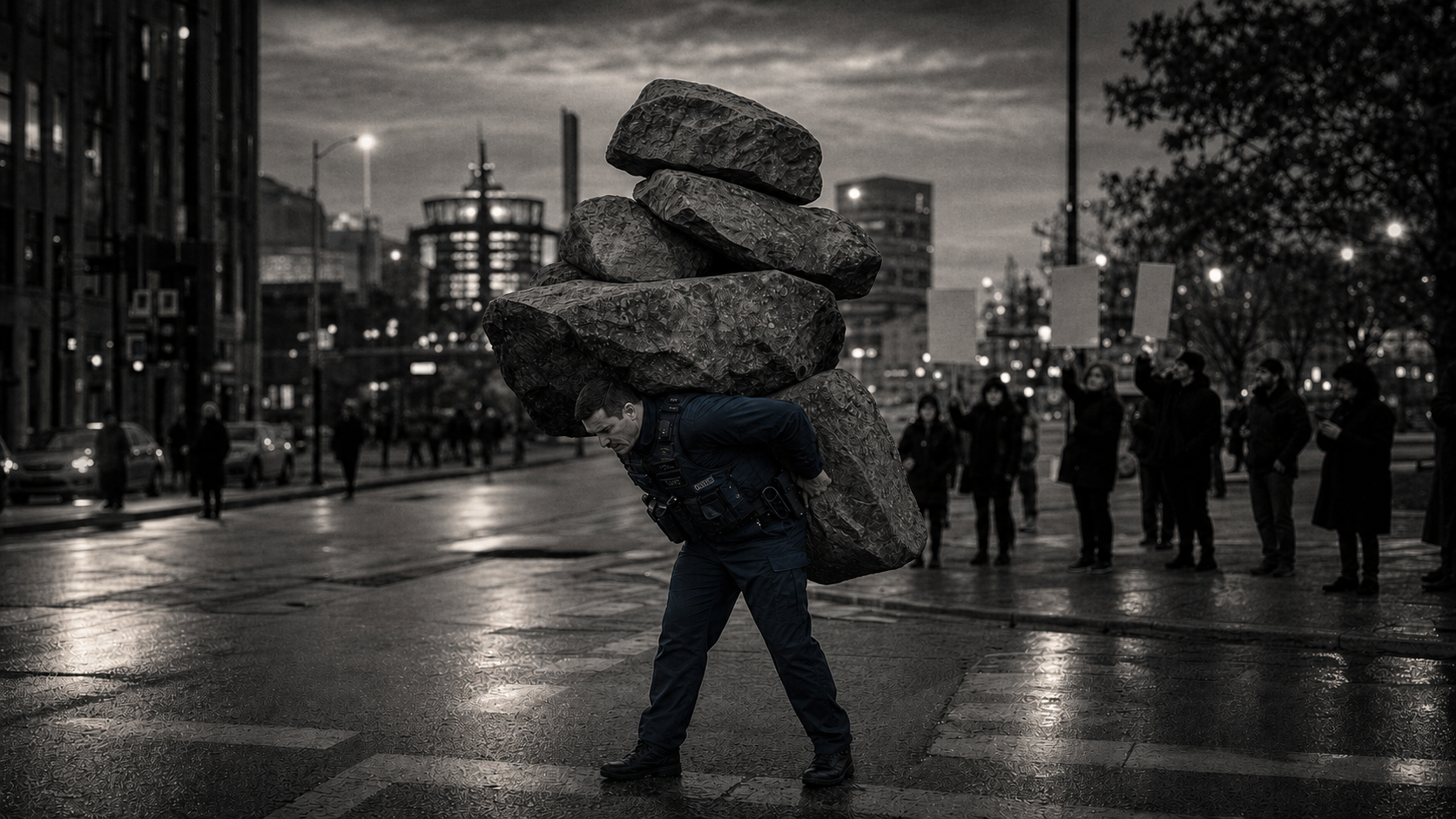
In the summer of 2020 a two-panel comic went around. In the first panel an officer staggers under a pile of boulders: homelessness, drug possession, domestic violence, school security, every unexpected crisis. A bystander points at a protest sign and objects: defund the police? How is he supposed to carry all that? The second panel answers in two words, while every boulder is carried off by the service actually built for it.
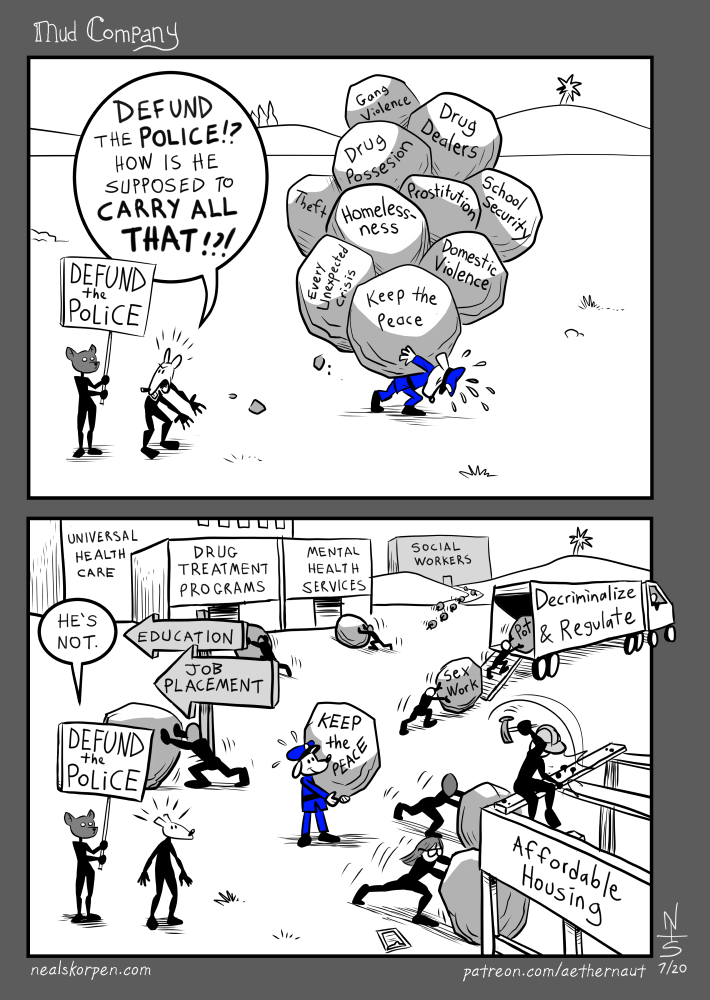
The comic argues at street level. This site follows the boulders indoors, because nobody hands an officer eight boulders on a street corner. The pile is assembled earlier, in rooms the public never sees: the academy, where the job is taught as everything; the locker room, where the savior story is kept inflated; and roll call, where the day's impossible list is read out as if it were normal. What follows is the public record of each room, and of the crews already carrying boulders out of the building.
7 chapters · tap any chapter to jump
01. Where the load is taught
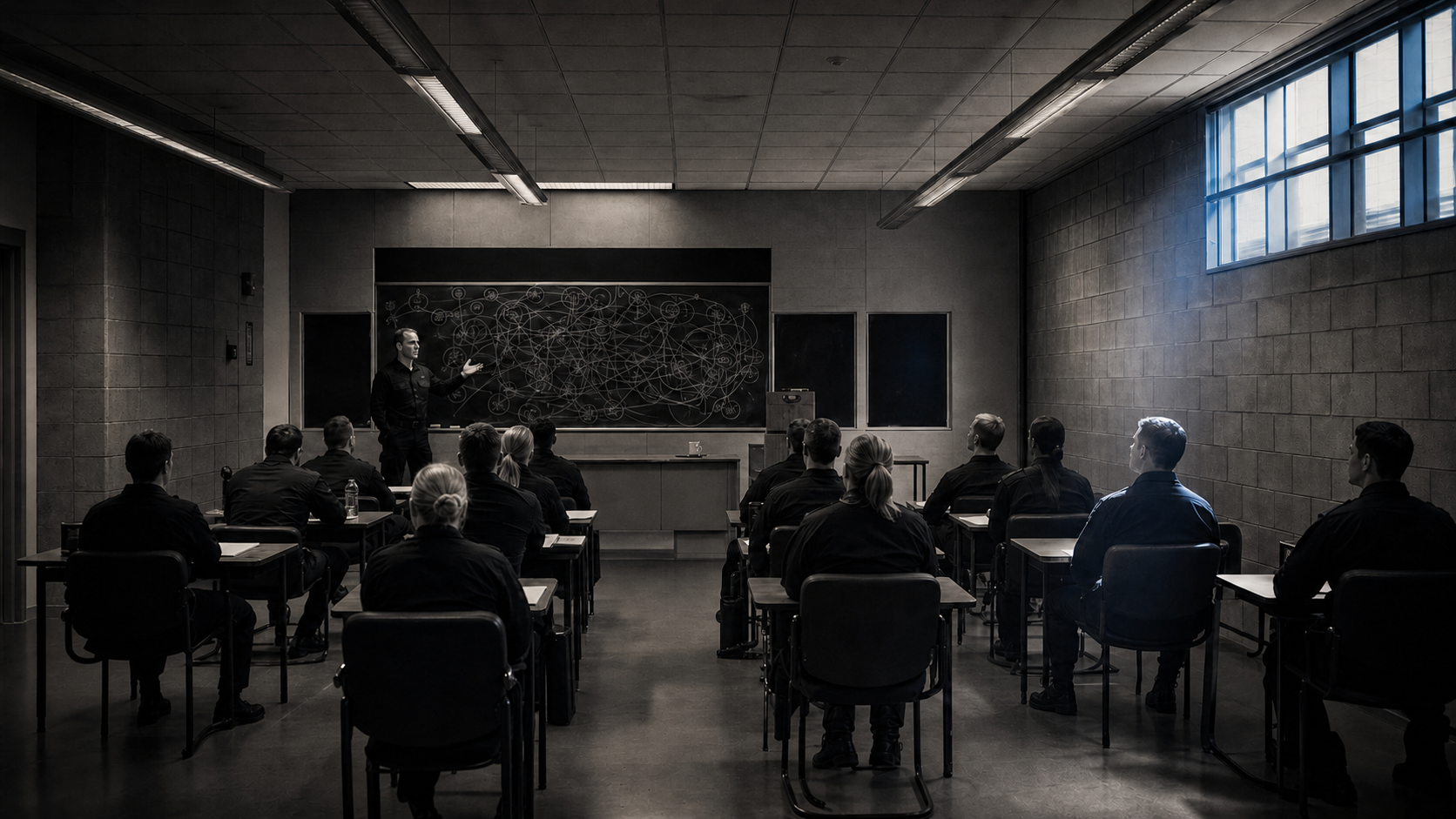
The national academy is in Regina. Every RCMP officer in the country starts at Depot Division: 26 weeks, 820 instructional hours. The force publishes the curriculum, so you can read exactly what those hours buy.
Ontario runs the biggest provincial pipeline: Basic Constable Training at the Ontario Police College is 12 weeks. The first dedicated mental-health crisis course for Ontario recruits was added in July 2023. It is three days long: 18 hours, for the category of call that fills more police time than any crime.
The American numbers make the proportions unmistakable. When the Police Executive Research Forum surveyed agencies, the median recruit got 58 hours of firearms training and 8 hours of de-escalation. Eight hours of crisis intervention. The average US academy runs about 21 weeks in total.
Now put the curriculum next to the people the boulders actually belong to.
This room is where the savior is inflated. A recruit spends 104 hours learning to shoot and is told the rest of the human condition will be integrated somewhere in the margins. The lesson underneath the curriculum is the load itself: whatever comes, it is yours. Nobody says it as a sentence. The timetable says it every day.
02. Where the story is kept inflated
Training builds the load; culture maintains it. The story told between shifts is the thin blue line: one wall between order and chaos, and you are the wall. It is a flattering story, and it is load-bearing in exactly the wrong direction. If you are the only thing holding society together, then every boulder is rightfully yours, and every attempt to move one is an attack on the wall.
Police researchers have a name for the two postures a department can train toward: the warrior, who patrols a battlefield, and the guardian, who serves a neighbourhood. The warrior posture is not just a mindset problem. It is a job-description problem. A warrior cannot triage; there is no boulder a warrior is allowed to put down.
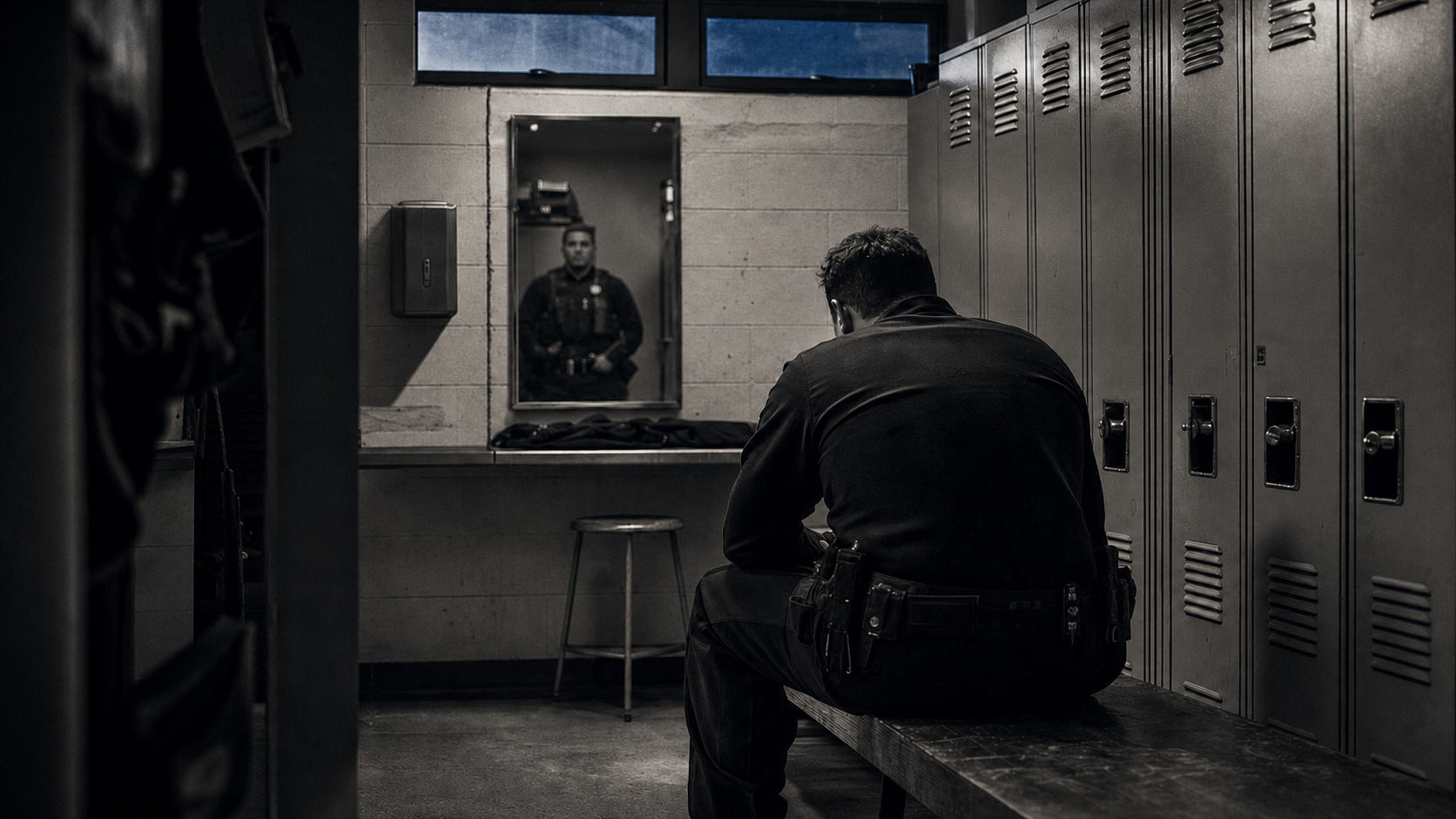
The mirror in this room runs a size too big. The reflection is the savior; the man on the bench is a person with 12 weeks of training and a radio that will not stop. Deflating the reflection is not an insult to him. It is the only way he and the job ever end up the same size.
03. Where the load is assigned
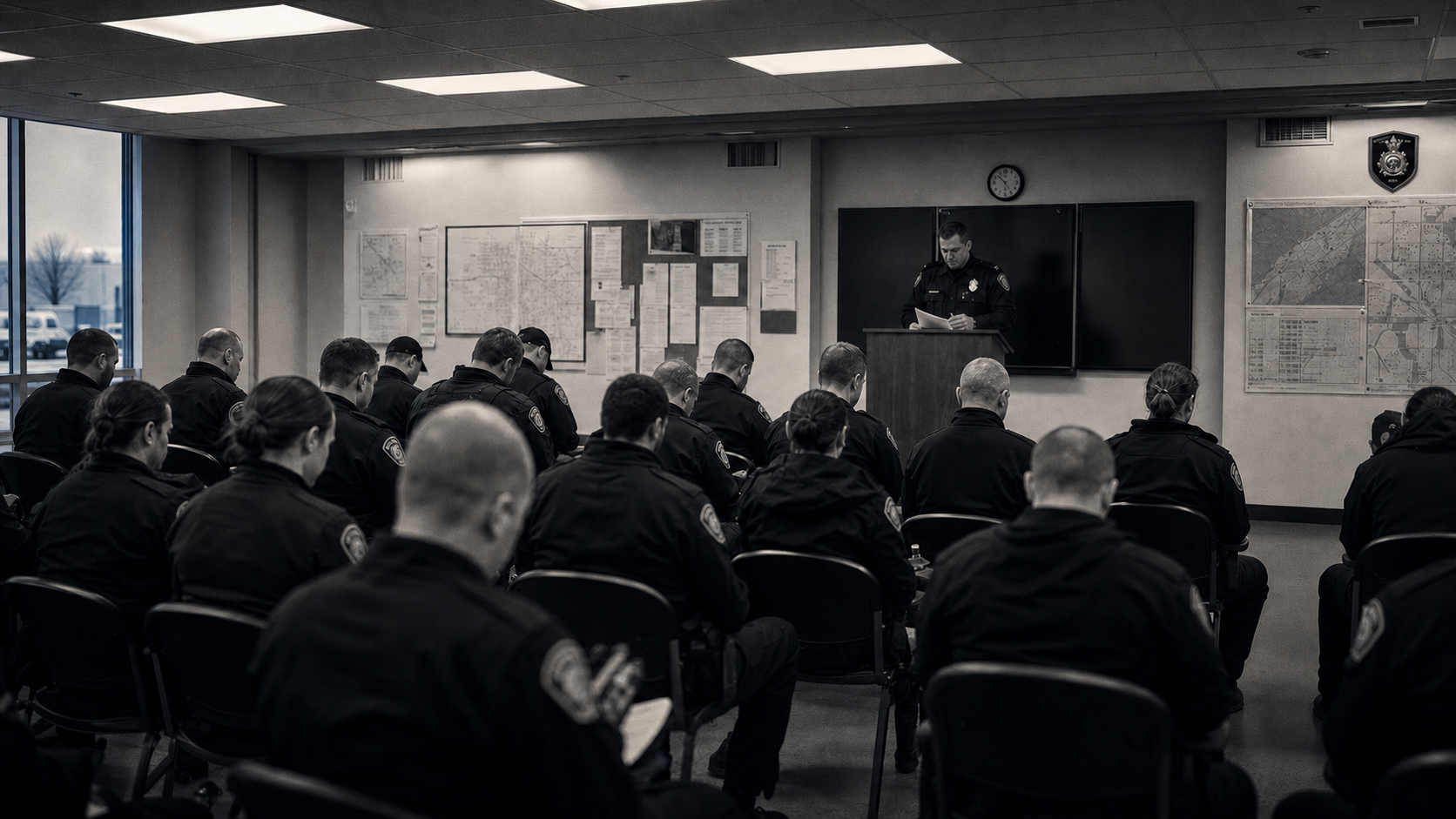
Roll call is where the pile becomes a shift. Whatever came into 911 overnight is read out here, and all of it is his, because the dispatch system has exactly one shape of responder to send. The city audited what is actually on that board. Tap the boulders.
of the 911 calls Toronto's Auditor General examined were not for police, fire, or paramedics at all. Roughly one call in eight arrived at the wrong building entirely.
of 911 calls were requests for advice. The most heavily armed responder in the city is also its best-advertised help line.
more were non-emergencies with no imminent danger or injury. Add the misdials and advice calls and roughly a third of the queue never needed lights or a gun.
of calls in the six lower-priority call types the Auditor General sampled could have been handled by a non-police response, had one existed to send. The audit also found about 85,000 police staff hours over five years could be freed by diverting some non-emergency calls.
of calls for service are violent crime, across ten US cities analysed in 2020, and about 4% of an officer's time. The core of the job description is a rounding error in the actual workload. No comparable share has been published for Toronto; the audits count what is divertible, not what is violent.
Read the board honestly and the roll-call sergeant is not assigning police work. He is assigning the unhandled residue of every underfunded system in the city, to the only crew that legally cannot say no. This room is where a supervisor could say the true sentence out loud: most of this board is not ours. The next scene is what happens when nobody says it.
04. Where everyone finally sees it
By the time the pile is visible on a corner, every decision that built it was already made indoors. The bystander in the comic is right about one thing: he really cannot carry all that. Nobody can. The 8-hour crisis course meets a psychotic break at 3 a.m.; the 104 firearms hours are the tool that came with the hand. When the load slips, it lands on whoever is underneath, and the officer is the second person crushed by it.
One more thing is true on this street, and it belongs on the record: Canadian and American courts have repeatedly held that police owe no enforceable duty to protect any particular person. The savior story is not even a contract. It is a costume. The full case law is at nopublicduty.
05. Where the load is set down
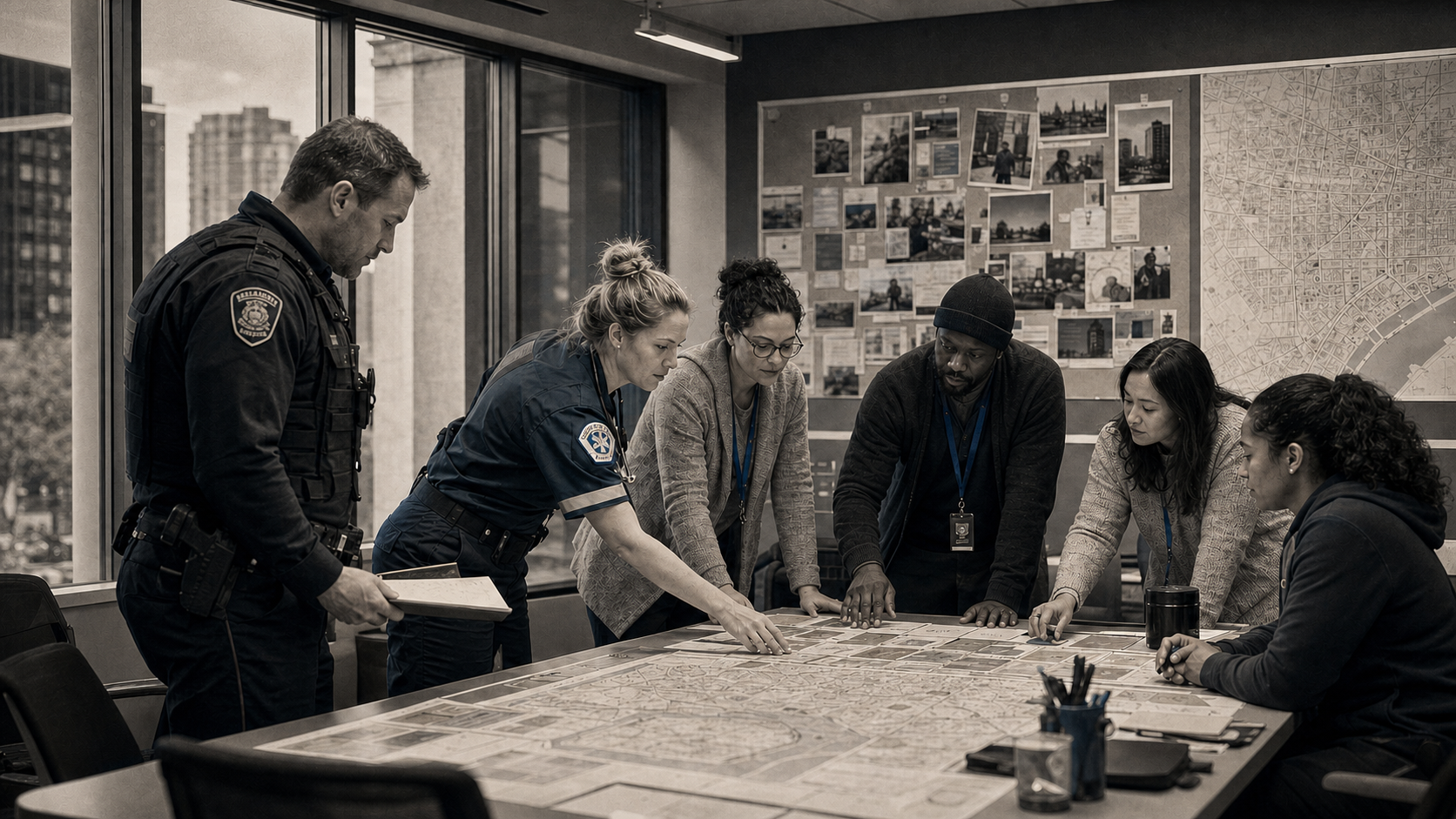
Panel two of the comic is not a fantasy. Every arrow on that board is a program that already runs, with published results. The deflation happens in the same rooms as the inflation: a curriculum that teaches one job instead of all of them, a culture that lets the mirror match the man, and a roll call where most of the old board has a different name beside it.
What is left for the officer is a real job, and an honest one: violence in progress, the small violent fraction of the board that was always the actual point. One stone, carried by someone finally trained to its weight, backed by services instead of substituting for them. The comic's whole argument fits in the gap between the two panels: defunding was never about erasing the figure in blue. It is about letting him put the pile down.
The savior is deflated the same way he was inflated: at the academy, in the locker room, at roll call. Rooms have doors. The boulders fit through them.
Field note · August 2026
Recruitment is an intake number. Capacity is a balance sheet.
The red tunic can stay perfectly visible while the operational number underneath it changes. A graduation ceremony counts people coming through one door. It does not count attrition, vacancies, leave, transfers out of front-line work, or the uneven distribution of the officers who remain.
That distinction is no longer hypothetical. The RCMP's own 2026 recruitment strategy says ongoing attrition has left its regular-member population with “virtually no growth.” The strategy's target is to get the ratio of graduating cadets to member attrition above 1:1 by 2028–29. That is a plan for net growth, not evidence that net growth has already happened.
The honest public measure is therefore net deployable strength by place and function—not applications, cadet pay, total spending, or ceremonial visibility in isolation. Budget 2025 complicates the picture further: it funds 1,000 additional personnel for federal policing while also scheduling administrative savings through centralization, restructuring and greater use of technology and systems. Expansion in one business line can coexist with shortage in another.
What the record does not yet establish is a deliberate five-year population reduction, a concealed plan to let retirements outrun graduations, or the replacement of officers by AI, robots or drones. Those claims require annual separation data, deployable-strength tables, line-item spending and procurement records. Until then, the defensible finding is narrower: the RCMP's recruitment image is a poor proxy for the number, location and work of officers actually available.
Receipts
- RCMP, Cadet Training Program, Depot Division: 26 weeks, 820 hours, official curriculum breakdown. rcmp.ca
- Public Safety Canada, parliamentary materials on RCMP crisis-intervention and de-escalation training being "integrated" rather than itemized. publicsafety.gc.ca
- Ontario Association of Chiefs of Police, recruitment FAQ: Basic Constable Training at the Ontario Police College is 12 weeks. jobs.oacp.ca
- CBC News, July 2023: Ontario adds an 18-hour, three-day mental-health crisis course to recruit training, the first of its kind at OPC. cbc.ca
- Police Executive Research Forum, Re-Engineering Training on Police Use of Force, 2015: median recruit hours, firearms 58, defensive tactics 49, de-escalation 8, crisis intervention 8. policeforum.org
- US Bureau of Justice Statistics, law-enforcement training academies, 2018: average basic training 833 hours, about 21 weeks. bjs.ojp.gov
- St. Thomas University, Bachelor of Social Work: a four-year degree. stu.ca
- College of Nurses of Ontario, approved baccalaureate (BScN) programs required for RN practice. cno.org
- Saskatchewan Polytechnic, Primary Care Paramedic: 51-week certificate. saskpolytech.ca
- Toronto Auditor General, 2022, review of police calls for service: about 40% of sampled lower-priority call types suitable for alternative response; about 85,000 police staff hours divertible over five years. torontoauditor.ca
- Toronto Auditor General, 2022, 911 operations audit: 12% of calls not for police or emergency services, 14% requests for advice, 10% non-emergencies. torontoauditor.ca
- New York Times Upshot, June 2020 (Asher and Horwitz): about 4% of police time on violent crime; violent-crime calls about 1% of calls for service across ten US cities. nytimes.com
- City of Toronto, 2023 update on the Toronto Community Crisis Service: 6,827 calls in year one, 78% resolved without police, 95% satisfaction. toronto.ca
- CBC News, 2024: TCCS past 10,000 calls at 78% without police; council vote to make it a fourth emergency service. cbc.ca
- NPR, June 2020: CAHOOTS handled about 17% of Eugene police call volume; about 24,000 calls in 2019 with police backup roughly 150 times; $2.1M budget beside $90M combined police budgets; estimated $8.5M annual savings. npr.org
- Dee, T. and Pyne, J., Science Advances 8, eabm2106, 2022: Denver STAR pilot reduced targeted low-level offences by 34%; about $151 per offence prevented against roughly $646 in direct criminal-justice cost. science.org
- Vancouver Police Department and CBC, 2023: Car 87 running since 1978, Car 88 added 2020, about 200 requests monthly, $2.8M expansion grant. vpd.ca
- Auditor General of Canada, 2026, Recruiting for the Royal Canadian Mounted Police: recruitment targets, hires, operational need, vacancy rates, class capacity and assignment findings. canada.ca
- RCMP National Recruitment Strategy 2026–2029: virtually no regular-member growth, current demand, attrition-ratio target and planned cadet output. rcmp.ca
- RCMP Remotely Piloted Aircraft System program and Saskatchewan expansion project: documented operational uses and the objective of access in every Saskatchewan detachment. rcmp-grc.gc.ca
- Government of Canada, Budget 2025 expenditure review: 1,000 additional federal-policing personnel alongside headquarters restructuring, administrative savings and increased use of technology and systems. budget.canada.ca